

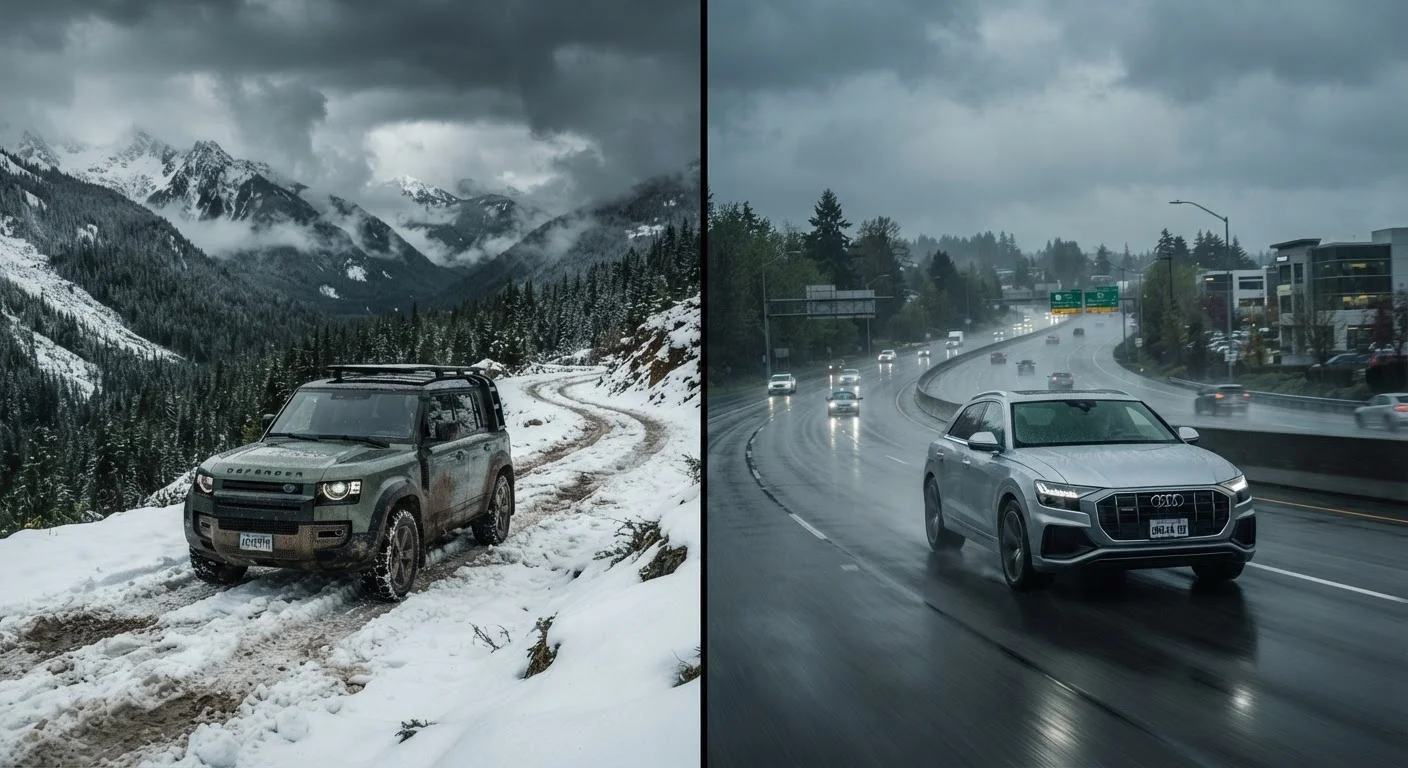
Option A
All-Wheel Drive (AWD)
The always-on, seamless traction system for everyday driving.
Best for: Drivers who frequently encounter rain, light snow, or mixed road conditions and want automatic traction management with no driver input.
Option B
Four-Wheel Drive (4WD)
The driver-selectable, high-torque system built for serious off-road demands.
Best for: Drivers who regularly tackle deep mud, rocky trails, heavy snow, or tow heavy loads and need maximum mechanical grip on demand.
How Each System Actually Works
The terms AWD and 4WD are often used interchangeably in showrooms and advertisements - but they describe fundamentally different engineering approaches to getting power to the ground.
All-Wheel Drive (AWD) uses a center differential or a sophisticated electronic torque-management system to continuously vary how much power goes to each axle - and in some systems, each individual wheel. The driver never has to think about it. When a sensor detects wheel slip, power is automatically redirected to the wheels with the most grip. AWD is always active, which makes it well-suited to varied road conditions that change unpredictably.
Four-Wheel Drive (4WD) traditionally works by mechanically locking the front and rear axles together so they rotate at the same speed. This is achieved through a transfer case, which splits power between the axles. Most 4WD systems offer two or three settings: 2H (two-wheel drive for normal use), 4H (four-wheel high, for slippery surfaces at moderate speeds), and 4L (four-wheel low, for maximum torque at very low speeds). In part-time 4WD systems, the driver must manually engage 4WD. Full-time 4WD runs constantly, similar in concept to AWD, though the hardware remains different.
For a broader picture of how power is managed from the engine outward, see our guide to transmission types - the transmission is the critical link between the engine and whatever drive system your vehicle uses.
| Criterion | AWD | 4WD |
|---|---|---|
| Engagement | Automatic, always active | Driver-selected (part-time) or always-on (full-time) |
| Primary use case | On-road traction in mixed weather | Off-road and heavy-duty terrain |
| Torque distribution | Variable, electronically managed | Mechanically locked axles (in 4L/4H) |
| Low-range gearing | Rarely available | Typically included (4L setting) |
| Dry pavement use | Safe in all conditions | Locked modes unsafe on dry pavement |
| Fuel economy impact | Moderate penalty vs. 2WD | Moderate to higher penalty vs. 2WD |
| Common vehicle types | Crossovers, sedans, wagons | Pickup trucks, body-on-frame SUVs |
| Driver knowledge required | Minimal - system manages itself | Higher - mode selection matters |
When Each System Has a Real Advantage
The practical difference becomes clear when you match each system to its intended environment.
Where AWD Excels
AWD shines on paved roads in wet, snowy, or icy conditions. A commuter navigating rain-slicked highways or light winter snow will benefit from AWD's ability to redistribute torque instantly and invisibly. Because it requires no driver input, there is less risk of misuse. Many crossovers and sedans sold with AWD are designed primarily as on-road vehicles, and the system works within that context effectively.
That said, AWD does not make a vehicle unstoppable. It improves acceleration traction but does not improve braking performance. Driving in adverse weather still requires adjusted speed, increased following distance, and smooth inputs - regardless of drivetrain.
Where 4WD Excels
4WD is built for situations where AWD would be overwhelmed: deep mud, loose rock, sand, and heavy snow where wheels need sustained, equal torque to all four corners. The 4L (low range) setting multiplies torque dramatically, allowing slow, controlled movement over obstacles. For towing on difficult terrain or recovery situations, 4WD's mechanical locking is more reliable under sustained stress than electronically managed AWD.
One critical caution: never use a locked 4WD mode on dry pavement. Because the front and rear axles are forced to turn at the same rate, turning on a solid surface creates driveline binding - stress that can damage the transfer case, differentials, or driveshafts. Always disengage to 2H or use an auto mode when returning to normal roads.
~82%
US new vehicle AWD/4WD take rate
According to industry data from Wards Intelligence, the share of new vehicles sold in the US with AWD or 4WD has risen substantially over the past decade, exceeding 80% in recent model years.
3-5%
Typical AWD fuel economy penalty
The US Department of Energy estimates AWD systems typically reduce fuel economy by roughly 3 to 5 percent compared to equivalent front- or rear-wheel-drive models.
4x
Torque multiplication in 4WD low range
A 4WD low-range (4L) transfer case can multiply available torque by roughly four times compared to high-range settings, enabling controlled movement over extreme terrain at low speeds.
The Trade-Offs Both Systems Carry
Neither AWD nor 4WD is a free upgrade. Both add weight, mechanical complexity, and cost - in purchase price, fuel economy, and eventual maintenance.
AWD systems, because they are always engaged, contribute to a small but measurable fuel economy penalty compared to equivalent two-wheel-drive models. The additional hardware - extra driveshaft, differential, electronic controllers - also represents more components that can eventually require service.
4WD vehicles, particularly truck-based designs with solid front axles and transfer cases, add significant weight and can feel less refined during everyday on-road driving. They also require periodic maintenance of the transfer case fluid and front differential, tasks that are easy to overlook.
Critically, neither system compensates for worn tires. Traction begins where the rubber meets the road. A vehicle with AWD on bald tires will perform worse than a two-wheel-drive vehicle on quality winter tires. Review our tire pressure and tread depth field guide to understand how tires affect your actual grip before assuming your drivetrain is doing the heavy lifting.
Understanding your vehicle's drivetrain also connects to broader maintenance decisions. Just as choosing the wrong motor oil type can affect engine longevity, using incorrect differential or transfer case fluids can shorten drivetrain life considerably. Consult your owner's manual for the specified service intervals and fluid types for your specific system.
AWD and 4WD Labels Vary by Manufacturer
Automakers do not use standardized definitions for AWD and 4WD. Some brands market full-time 4WD systems as AWD, while others apply the 4WD label to electronically controlled systems with no mechanical locking. When evaluating a vehicle, look at how the system actually functions - whether it has a low-range transfer case, whether locking modes are available, and how torque is distributed - rather than relying solely on the badge. Your owner's manual and manufacturer specs will provide the clearest picture.
The content provided on our blog site traverses numerous categories, offering readers valuable and practical information. Readers can use the editorial team’s research and data to gain more insights into their topics of interest. However, they are requested not to treat the articles as conclusive. The website team cannot be held responsible for differences in data or inaccuracies found across other platforms. Please also note that the site might also miss out on various schemes and offers available that the readers may find more beneficial than the ones we cover.