

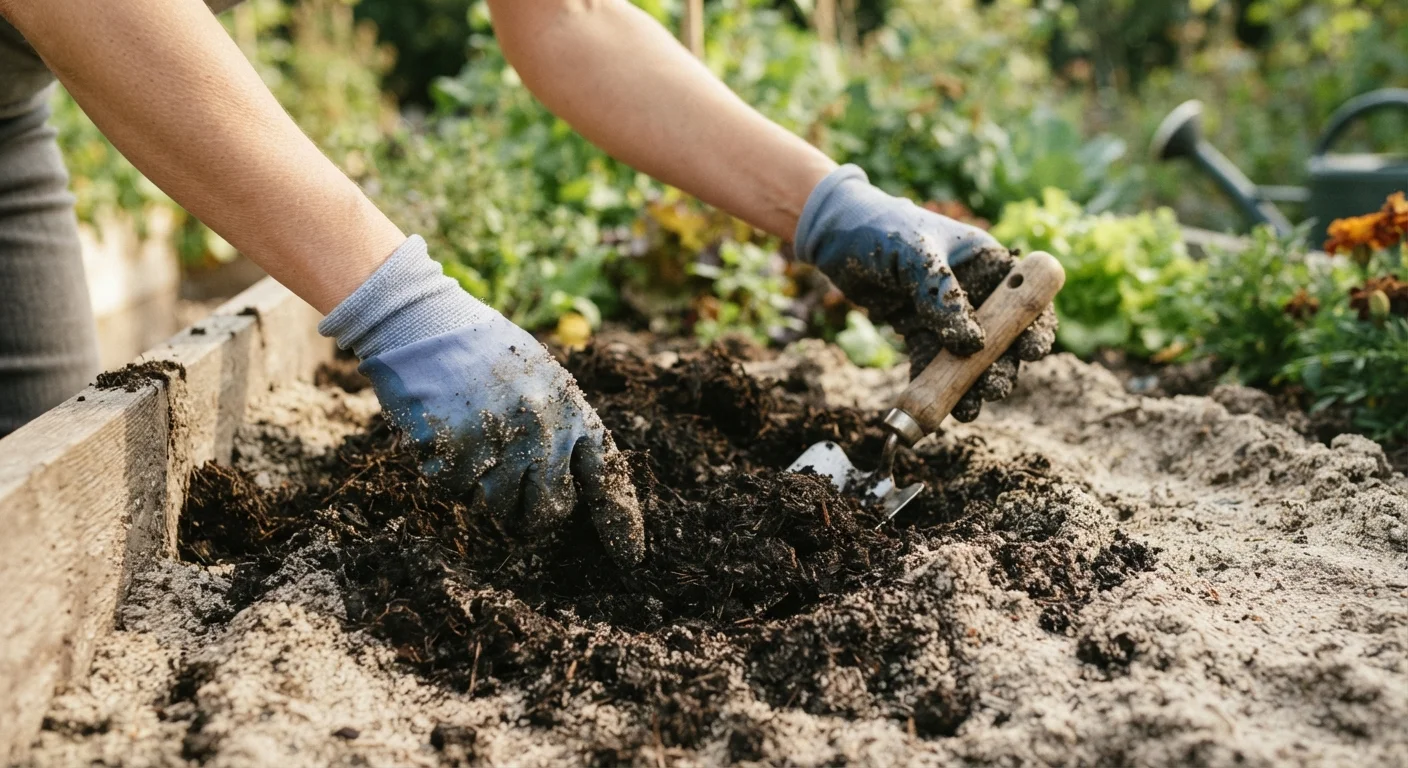
Why Soil Structure Matters More Than You Might Think
Many gardeners focus on fertilizing plants when things go wrong, but the root cause - literally - is often the soil itself. Soil isn't just a medium that holds plants upright. It's a living system of mineral particles, air pockets, water channels, organic matter, and billions of microorganisms. When that system is out of balance, plants struggle regardless of how much fertilizer you apply.
Healthy garden soil drains well but retains enough moisture for roots to access between waterings. It holds together loosely so roots can penetrate easily, and it supports the microbial life that breaks down organic matter into plant-available nutrients. Soil that's too compacted, too sandy, too acidic, or too alkaline disrupts each of these functions.
That's where amendments come in - not as a quick fix, but as a way to correct underlying conditions so plants can do what they're naturally capable of doing.
Start With a Soil Test Before You Buy Anything
Before purchasing any amendment, invest in a basic soil test. Applying lime to soil that isn't acidic, or adding sand to clay without organic matter, can make soil worse rather than better. Your local cooperative extension office is often the most affordable and reliable testing source. Results typically include specific amendment recommendations for your region and crop type.
The Most Common Soil Amendments and What Each One Does
Understanding what you're working with helps you make targeted choices rather than guessing.
- Compost: Decomposed organic matter that improves soil structure in almost every soil type - loosening clay and adding water retention to sandy soils. It also feeds soil microbes and releases nutrients slowly. It's the single most universally useful amendment.
- Lime (agricultural limestone): Raises soil pH in overly acidic soils. Most commonly needed in regions with high rainfall, where soil naturally acidifies over time. Different forms - calcitic and dolomitic - vary in magnesium content, so a soil test guides the right choice.
- Sulfur: Lowers soil pH in alkaline soils. Useful in arid climates where soils trend basic. Works slowly - plan several months ahead before planting.
- Perlite: A lightweight volcanic material that improves drainage and aeration, particularly in container mixes or heavy clay beds.
- Aged manure: Adds organic matter and a broad range of nutrients. Must be well-composted before use - fresh manure can burn plants and introduce pathogens.
- Biochar: Charred organic material that improves soil's ability to retain nutrients and moisture. Research is ongoing, but it shows promise particularly in nutrient-poor soils.
6.0-7.0
Ideal pH range for most vegetables
Most vegetable crops and common ornamentals perform best within this slightly acidic to neutral pH range, according to general horticultural guidance from university extension programs.
2-4 inches
Recommended compost layer to incorporate
Working 2-4 inches of compost into the top 6-8 inches of soil is a widely cited starting guideline for improving soil structure in new garden beds.
1 billion+
Microorganisms per teaspoon of healthy soil
USDA research indicates that a single teaspoon of healthy garden soil can contain more than one billion bacteria, underscoring why soil biology matters as much as chemistry.
How to Tell If Your Garden Actually Needs Amendments
The most reliable tool is a soil test. Many university cooperative extension offices offer affordable testing, and the results typically include pH, nutrient levels, and specific amendment recommendations for your soil type and intended plants. This removes the guesswork and prevents the common mistake of adding amendments your soil doesn't need.
Beyond testing, observe your soil's behavior:
- Water pools or drains very slowly after rain - may indicate compaction or heavy clay content.
- Soil repels water or runs off immediately - may indicate very low organic matter or a sandy, hydrophobic surface.
- Plants are consistently pale, stunted, or show yellowing in patterns - may point to pH-related nutrient lockout rather than simple deficiency.
- Soil cracks and hardens into chunks when dry - a classic sign of clay-heavy soil that needs organic matter.
If you're setting up a new planting area, see our guide to raised beds vs. in-ground planting - soil quality considerations differ significantly between the two.
pH Affects More Than Just Acidity
Soil pH doesn't just measure how acidic or alkaline your soil is - it controls which nutrients are chemically available to plant roots. Iron, manganese, and boron become less available as pH rises; calcium, phosphorus, and magnesium become less available as pH drops. A plant showing iron deficiency symptoms may actually have plenty of iron in the soil - it just can't access it due to high pH. This is why correcting pH often solves apparent nutrient problems without adding any extra fertilizer.
Applying Amendments Correctly - and When to Hold Back
More is rarely better when it comes to amendments. Adding lime to soil that doesn't need it raises pH beyond the ideal range, locking out nutrients like iron and manganese. Adding too much compost can load soil with excess phosphorus. Even drainage-focused amendments like perlite or coarse sand can compact differently than expected if applied incorrectly to clay-heavy ground.
The general approach for organic amendments like compost is to work 2-4 inches into the top 6-8 inches of soil before planting, and to reapply as a surface mulch or top-dress annually. For pH corrections, follow the specific rates from your soil test results - and expect lime to take several months to fully shift pH.
If you're starting a vegetable garden for the first time, our beginner's guide to starting a vegetable garden covers soil prep in the context of a full planting plan. And once your soil is healthy, pairing that foundation with the right mulch can help maintain moisture and soil temperature between seasons.
Soil amendment is ultimately an ongoing relationship with your garden, not a one-time project. Test regularly, observe your plants, and adjust incrementally - that's how soil steadily improves over growing seasons.
Frequently Asked Questions
Fertilizers supply nutrients - nitrogen, phosphorus, potassium - directly to plants. Soil amendments change the soil's structure, drainage, or chemistry over time. Compost, for example, does both: it slowly releases nutrients while also improving soil texture. Many gardeners use both, but they serve different purposes.
The clearest signal is a soil test, available through most university extension services or cooperative extension offices. Visual clues also help: soil that stays waterlogged, crusts over after rain, or produces consistently pale or stunted plants likely has structural or pH issues. Testing removes the guesswork.
Yes. While compost is generally forgiving, excessive amounts can over-concentrate certain nutrients, particularly phosphorus, which can interfere with plant uptake of other minerals. A general guideline is to work 2-4 inches of compost into the top 6-8 inches of soil, but a soil test helps you calibrate the right amount.
Lime raises soil pH, making acidic soil more neutral. This matters because most vegetables and common ornamentals grow best in a slightly acidic to neutral pH range (roughly 6.0-7.0). If your soil test shows pH below 6.0, lime is a common correction - but the type and amount depend on your specific soil.
Not exactly. Both can improve drainage, but perlite - a lightweight volcanic glass - is more effective in small quantities and won't compact over time. Coarse sand can work, but fine sand added to clay soil can actually worsen drainage by creating a concrete-like texture. Perlite is generally the safer choice for loosening clay.
Organic amendments like compost break down over time and benefit from annual or biennial reapplication. Mineral amendments like lime or sulfur are applied less frequently and based on soil test results - over-applying them can create new problems. Test your soil every two to three years as a general rhythm.
The content provided on our blog site traverses numerous categories, offering readers valuable and practical information. Readers can use the editorial team’s research and data to gain more insights into their topics of interest. However, they are requested not to treat the articles as conclusive. The website team cannot be held responsible for differences in data or inaccuracies found across other platforms. Please also note that the site might also miss out on various schemes and offers available that the readers may find more beneficial than the ones we cover.