

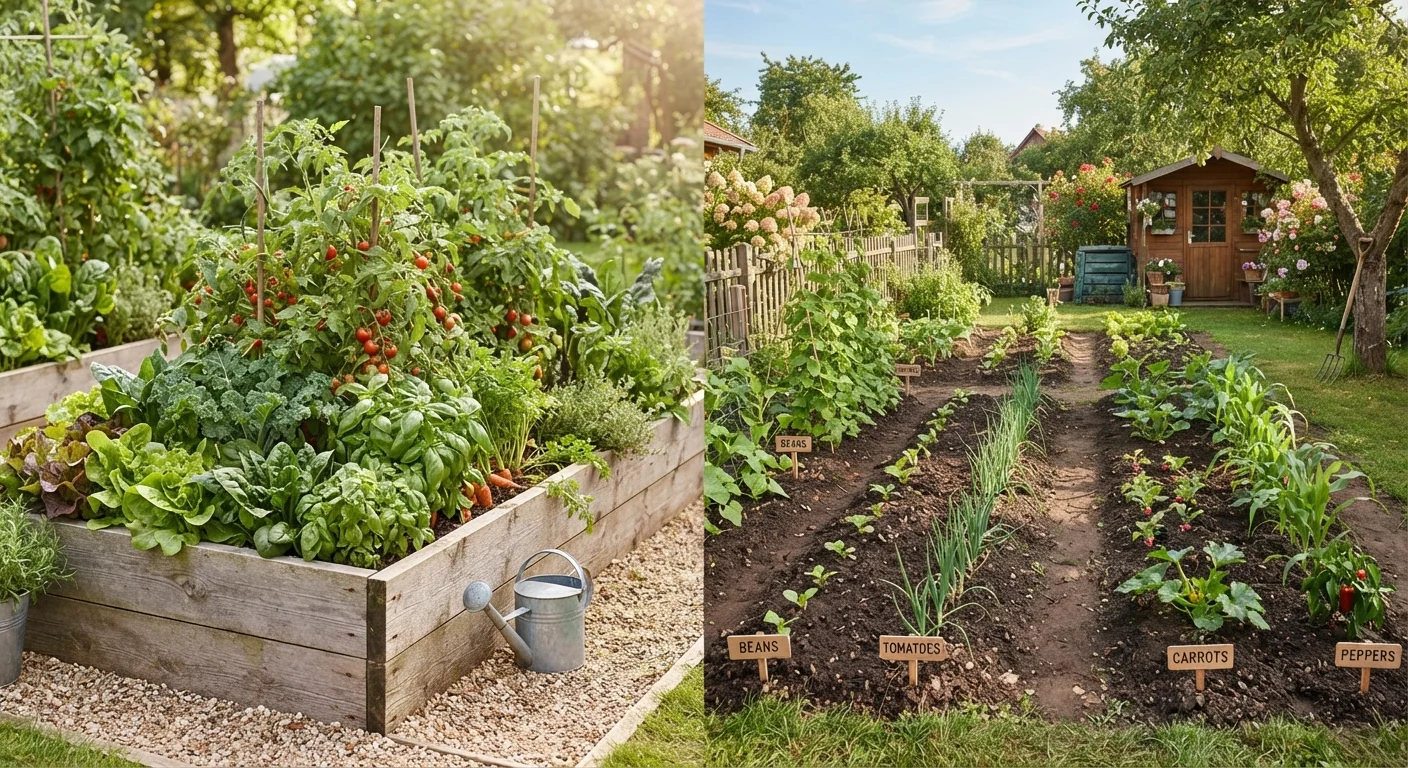
Option A
Raised Beds
The controlled, accessible setup for challenging conditions.
Best for: Gardeners dealing with poor native soil, limited mobility, short growing seasons, or small defined spaces.
Option B
In-Ground Planting
The low-cost, expansive approach for established soil.
Best for: Gardeners with workable native soil, larger planting areas, and flexibility to invest time in soil improvement over seasons.
What You're Actually Deciding
Choosing between raised beds and in-ground planting isn't about which method is objectively better - it's about which one fits your soil, space, physical comfort, and goals. Both approaches can produce excellent results. The real question is how much work each will require in your specific yard, and whether that work is worth it to you.
Before spending money on lumber or soil amendments, it pays to evaluate your situation honestly. Walk your yard after a heavy rain. If water pools and stays for hours, drainage is a problem. Squeeze a handful of soil: if it clumps into a tight ball and won't crumble, you're likely dealing with heavy clay. These two observations alone can point you toward the right setup. Understanding what's underfoot is foundational - see our guide to soil amendments for a deeper look at diagnosing and improving what you're working with.
Raised Beds: Strengths and Limitations
Raised beds give you near-total control over growing conditions. You fill them with a soil blend optimized for drainage, nutrient content, and texture - which means you're not at the mercy of whatever the previous owners left behind or what geology deposited under your lawn.
This control comes with real advantages. Soil in a raised bed warms faster in spring because it's exposed to air on all sides, which can extend your growing season by two to four weeks in cooler climates. Weeds are also easier to manage when you're starting with clean, imported soil, and the defined borders make it simpler to maintain clear lines between planting zones and pathways.
The downsides are cost and ongoing water demand. Building materials, hardware, and quality fill soil add up - especially if you're installing multiple beds. Once built, raised beds also dry out faster than in-ground gardens, so they typically need more frequent irrigation. Using a drip system can help considerably; our comparison of drip irrigation vs. sprinklers covers how to match watering method to your setup.
| Criterion | Raised Beds | In-Ground Planting |
|---|---|---|
| Upfront cost | Higher (materials + fill soil) | Lower (minimal materials needed) |
| Soil control | Full - you choose the mix | Limited to native soil improvement |
| Drainage | Excellent by design | Varies by site and native soil |
| Watering frequency | Higher - dries out faster | Lower - retains moisture longer |
| Season extension | Soil warms faster in spring | Slower to warm in cold climates |
| Weed pressure | Lower with clean imported soil | Higher without barriers or mulch |
| Scalability | Limited by cost and space | Scales easily across large areas |
| Root depth | Limited by bed depth | Unrestricted |
| Physical accessibility | High - adjustable working height | Requires kneeling or bending |
In-Ground Planting: Strengths and Limitations
In-ground gardens are the default for good reason: when the soil cooperates, they're efficient, affordable, and naturally connected to the surrounding ecosystem. Plant roots can extend as deep as they need to, and soil microbes, earthworms, and moisture retention all work in your favor when the native soil structure is healthy.
The challenge is that many American yards don't start with ideal soil. Decades of lawn care, construction fill, or simple regional geology can leave you with compacted, nutrient-poor ground that needs significant amendment before it performs well. This isn't impossible to fix - compost, cover crops, and consistent mulching can rehabilitate most soil over two to three seasons - but it takes patience. Our guide to backyard composting can help you build the organic matter your in-ground garden needs over time.
Weeding is also more demanding in-ground, since there's no physical barrier separating cultivated soil from the surrounding landscape. Applying the right mulch goes a long way; see our overview of mulch types for practical guidance on suppressing weeds while improving soil health.
6-8 inches
Minimum raised bed depth for most vegetables
University extension guidelines generally recommend at least 6 to 8 inches of soil depth for productive vegetable growing in raised beds.
~2-3 seasons
Time to meaningfully improve in-ground soil with compost
Consistent organic matter additions typically require two to three growing seasons to substantially improve soil structure and biology in degraded in-ground plots.
Up to 4 weeks
Extra growing time raised beds can provide in cool climates
Because raised bed soil warms faster in spring and cools more slowly in fall, gardeners in northern regions may gain several additional weeks of productive growing time.
How to Match Your Choice to Your Yard
A few practical criteria can help you make a confident decision:
- Soil test first: A basic soil test from your local cooperative extension office will tell you pH, nutrient levels, and texture. This costs very little and removes a lot of guesswork.
- Consider your plants: Compact vegetables, herbs, and annual flowers are well-suited to raised beds. Deep-rooted crops like squash, corn, or perennial plantings generally do better in-ground where roots aren't restricted. Our guide to perennials vs. annuals can help you plan for the long term.
- Map your space: Raised beds suit small, defined zones. If you're planning to garden across a large area, in-ground is usually more practical and economical to scale.
- Think about integration: Your garden doesn't exist in isolation. How it connects to pathways, seating, and the rest of your outdoor area matters. Our backyard planning guide can help you think through the full picture.
You Don't Have to Choose Just One
Many experienced home gardeners use a hybrid approach - raised beds for vegetables and herbs that benefit from controlled soil, and in-ground planting for perennials, shrubs, and larger plants that need unrestricted root space. Starting with one or two raised beds while maintaining an in-ground area lets you compare results in your specific yard before committing fully to either method.
The content provided on our blog site traverses numerous categories, offering readers valuable and practical information. Readers can use the editorial team’s research and data to gain more insights into their topics of interest. However, they are requested not to treat the articles as conclusive. The website team cannot be held responsible for differences in data or inaccuracies found across other platforms. Please also note that the site might also miss out on various schemes and offers available that the readers may find more beneficial than the ones we cover.