

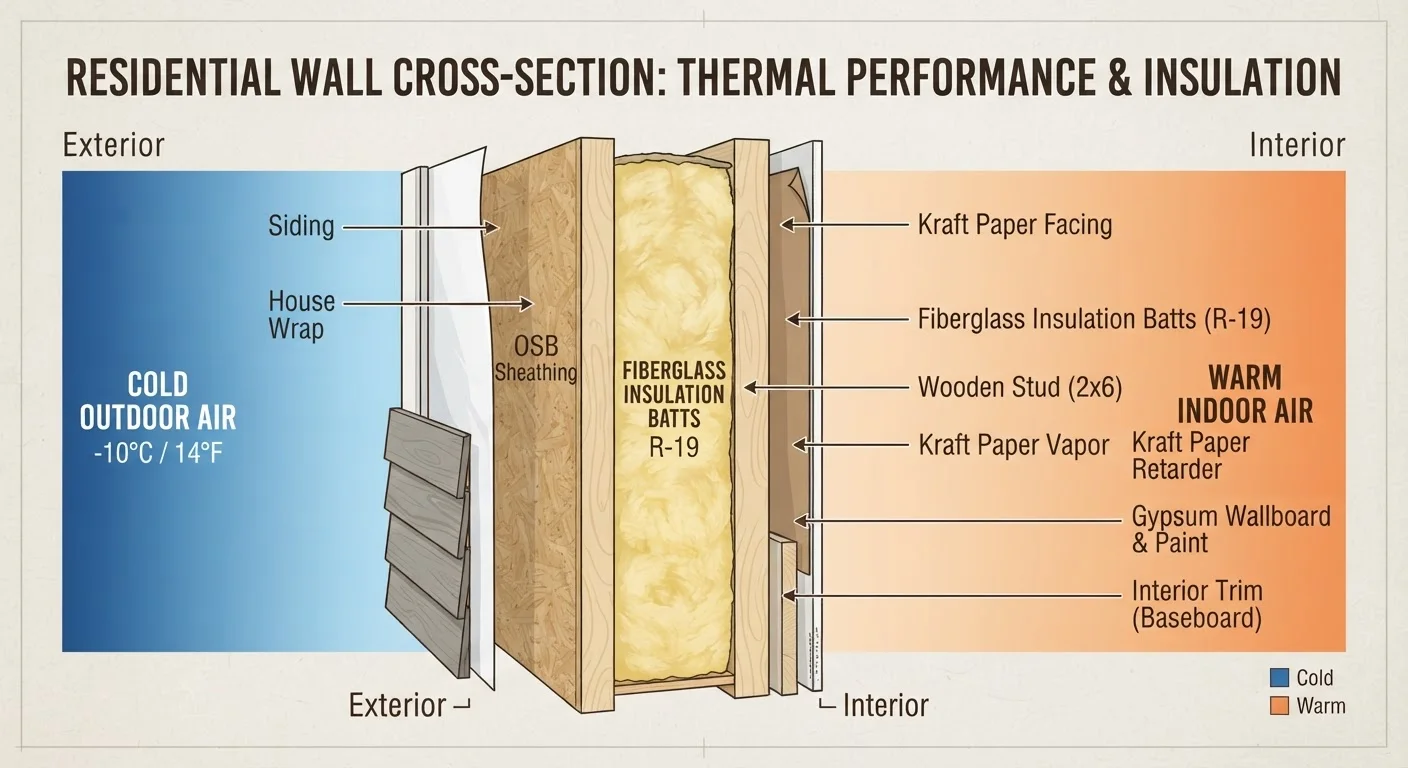
What R-Value Actually Measures
Think of heat like water finding its way through a wall. Insulation is the barrier that slows that movement. R-value quantifies exactly how effective that barrier is - specifically, how strongly a material resists the flow of heat from one side to the other.
A higher number always means better resistance. R-13 fiberglass batts (common in exterior walls) slow heat flow more than R-8 rigid foam board alone. Stack those two together and you get R-21 - because R-values are additive when layers are combined. That additive quality is one of the most useful things to understand when planning any insulation project.
What R-value does not measure is air leakage. Insulation and air sealing are related but distinct problems. A wall full of R-19 batts with gaps around outlets and top plates will underperform its rating because air bypasses the insulation entirely. Addressing both together is what actually moves the needle on home comfort.
R-Value Is Not the Whole Story
R-value rates a material's resistance to conductive heat flow, but homes also lose and gain heat through convection (air movement) and radiation. That's why air sealing and, in some climates, radiant barriers are addressed separately from insulation R-value. Think of R-value as one important chapter in your home's overall energy performance story, not the entire book.
Why R-Value Requirements Differ by Location
A home in Minnesota faces a fundamentally different thermal challenge than one in central Florida. That's why the U.S. Department of Energy maps the country into eight climate zones, each with its own recommended R-value ranges for different parts of the home.
In warmer southern zones (Zone 1-2), attic insulation targets often fall in the R-30 to R-38 range. In colder northern zones (Zone 6-7), those targets climb to R-49 to R-60 or more. Wall and floor recommendations shift similarly. Local building codes - which are typically derived from the International Energy Conservation Code - translate these ranges into legal minimums for new construction and major renovations.
If you're not sure which climate zone you're in, the DOE's online map makes it straightforward to look up. Your local building department can also tell you what code currently requires for your area. For a broader picture of what an energy professional looks at when evaluating your home, see our guide to home energy audits.
R-49-R-60
Recommended attic insulation range for cold northern U.S. climate zones
Per U.S. Department of Energy climate zone recommendations for zones 6 and 7.
~15%
Estimated share of U.S. homes considered under-insulated in attics
The North American Insulation Manufacturers Association has cited figures in this range based on housing stock surveys, though estimates vary by region and methodology.
R-value additive
Property that lets insulation layers be combined
Two layers with R-13 and R-8 combine to deliver R-21, giving homeowners flexibility to reach code targets incrementally.
R-Value by Location in Your Home
Not every part of your house needs the same R-value, because heat moves differently through different assemblies. Here's a plain breakdown of where R-value targets tend to differ most:
- Attic: Heat rises, so ceilings and attic floors are typically the highest-priority location. This is also where adding insulation is most accessible and cost-effective in existing homes.
- Exterior walls: Most standard 2×4 framed walls with fiberglass batts land around R-13 to R-15. Upgrading often requires adding continuous rigid foam on the exterior during a re-siding project, or using advanced framing techniques in new construction.
- Crawl spaces and basement walls: Whether you insulate the floor above an unconditioned crawl space or the crawl space walls themselves depends on whether it is vented or sealed - a distinction worth discussing with a contractor before acting.
- Cathedral ceilings: These require careful planning because there is limited depth available and ventilation must be maintained between the insulation and the roof deck. See attic ventilation basics for related vocabulary.
If you're planning a larger renovation and will be working with contractors, understanding how R-value specifications appear in estimates will help you ask sharper questions. Our article on reading a contractor's bid walks through what those line items mean.
Check What You Already Have Before Buying More
Before investing in new insulation, measure what's already in your attic. A simple ruler pressed into existing batts or blown-in material gives you a rough current R-value (check the manufacturer's chart for your material type). You may only need to add a partial layer rather than starting from scratch, which changes the project scope considerably.
Installation Quality: The Variable That Changes Everything
A roll of R-19 batt insulation is only R-19 when installed correctly. Compress it to fit a shallow cavity and its R-value drops. Leave gaps at edges or around obstructions, and heat finds those paths instead of moving through the insulation. This real-world gap between rated and actual performance is sometimes called installation factor or thermal bypass.
Common installation mistakes that reduce effective R-value include:
- Compressing batts to fit thinner cavities than they're rated for
- Leaving voids around wiring, pipes, or junction boxes
- Failing to extend insulation to the outer edges of top plates
- Not air-sealing penetrations before insulating over them
This is why building code inspections exist for insulation in permitted renovation work. Before any work is covered up by drywall, an inspector can verify that installation meets standards. For a clear picture of how that process works, our guide to permits and inspections explains the framework.
Frequently Asked Questions
A higher R-value means the material resists heat flow more effectively. In practical terms, better-insulated walls and ceilings keep conditioned air inside longer, reducing the workload on your heating and cooling system. The improvement you notice will depend on how well the rest of your home's envelope - windows, doors, air sealing - performs alongside the insulation.
No, but they are related. Different insulation materials achieve different R-values per inch of thickness. Spray closed-cell foam, for example, delivers a much higher R-value per inch than standard fiberglass batts. Thickness alone does not tell you how well a material insulates.
The U.S. Department of Energy divides the country into eight climate zones, each with its own recommended R-value ranges. Attic recommendations generally run from around R-30 in milder southern climates up to R-60 or higher in colder northern zones. Check the DOE's climate zone map or consult a local energy professional to find the right target for your area.
In many cases, yes. Attics are a common place where homeowners add a layer of blown-in insulation on top of existing batts. The R-values add together as long as the existing material is dry, undamaged, and not compressed. For walls, adding insulation typically requires more invasive work and is best evaluated by a contractor.
Most insulation materials maintain their rated R-value for decades if kept dry and undisturbed. Moisture is the biggest threat - wet insulation loses thermal resistance and can harbor mold. Settling in loose-fill products can reduce thickness over many years, which may lower effective R-value slightly.
A professional home energy auditor can measure your current insulation levels, identify air leaks, and recommend specific improvements based on your climate zone and home construction. This is especially useful before committing to a large insulation project, since targeting the right areas first typically delivers the greatest benefit.
The content provided on our blog site traverses numerous categories, offering readers valuable and practical information. Readers can use the editorial team’s research and data to gain more insights into their topics of interest. However, they are requested not to treat the articles as conclusive. The website team cannot be held responsible for differences in data or inaccuracies found across other platforms. Please also note that the site might also miss out on various schemes and offers available that the readers may find more beneficial than the ones we cover.