

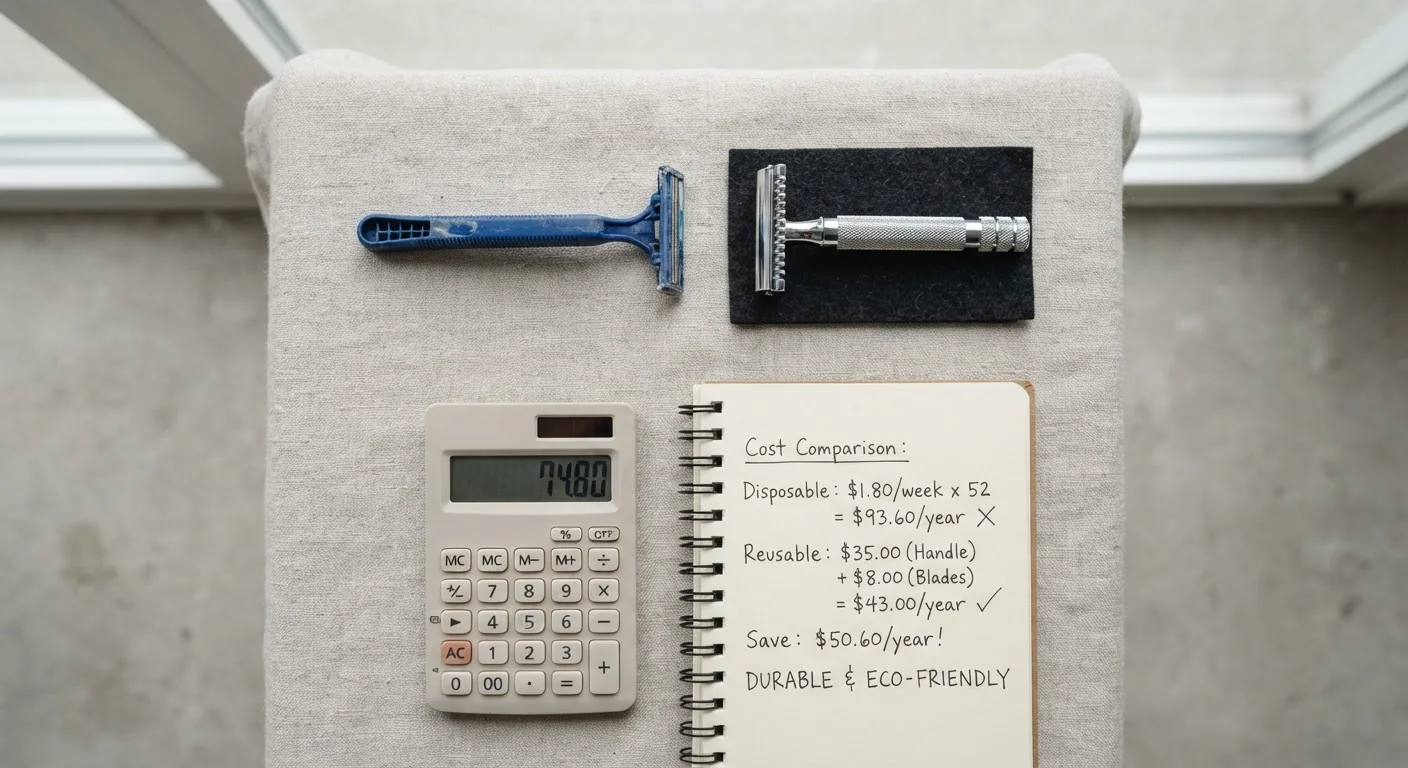
Why Sticker Price Misleads You
Most purchase decisions happen at the shelf or checkout page, where a single number dominates: the price tag. But that number captures only one moment - the transaction - not the full story of what something actually costs you over its lifetime.
Marketing is built around this blind spot. A product is promoted as "affordable" because its upfront price is low. What goes unmentioned is how often you'll replace it, how quickly it degrades, or how rarely you'll actually reach for it. The result is a budget that feels controlled but quietly leaks through repeated cheap purchases.
Cost per use reorients your thinking. Instead of asking "how much does this cost?" you ask "how much does each use cost me?" That shift in framing changes which items look like bargains and which look like traps. It's a core principle of smarter spending that applies across nearly every product category.
72%
Consumers who regret impulse purchases
According to a CreditCards.com survey, nearly three in four Americans say they've made impulse purchases they later regretted - often driven by low sticker prices rather than considered value.
3x
Replacement rate for low-quality goods
Consumer behavior research consistently finds that low-cost, low-durability items are replaced two to three times more frequently, which erodes any upfront savings.
$0.80
Cost per use on a $160 pan used 200 times
A straightforward cost-per-use calculation illustrating how a higher upfront price can translate to lower long-term spending when the item is used regularly.
How the Calculation Works
The formula is straightforward: Cost Per Use = Purchase Price ÷ Number of Uses. The challenge - and where most people stumble - is in the denominator.
Consider two scenarios. A $40 pan that you use 15 times before warping costs $2.67 per use. A $160 pan used 200 times costs $0.80 per use. The expensive pan is actually cheaper by every meaningful measure. Now apply the same logic in reverse: a $90 kitchen gadget you use three times before it gets shoved in a cabinet costs $30 per use - an expensive novelty no matter how it was marketed.
Honest estimation is the hardest part. Most people overestimate how frequently they'll use something at the moment of purchase. Behavioral researchers have documented this optimism bias in consumer decision-making for decades. To counteract it, base your estimate on how often you currently do the activity, not how often you plan to.
Use your current habits, not your goals
When estimating how many times you'll use something, look at your actual behavior over the past month - not your intentions going forward. If you haven't been cooking at home three times a week, don't project that as future usage. Honest estimates make the math genuinely useful; optimistic ones just justify purchases you've already emotionally decided on.
For items with ongoing maintenance costs - like certain appliances, tools, or footwear requiring resoling - add those expenses to the purchase price before dividing. This gives you a total cost of ownership per use rather than just the acquisition cost per use. This connects naturally to the hidden costs worth factoring in before you buy.
When Higher Upfront Cost Makes Sense
Cost per use logic is most powerful when applied to high-frequency, long-lifespan items. Daily-use products - work shoes, a commuter bag, a kitchen knife, headphones - accumulate uses quickly, which rapidly reduces the per-use cost even on expensive versions. Paying more upfront for durability and quality can be the economically rational decision, not a luxury indulgence.
The calculus flips for occasional-use items. If you exercise three times a year, premium workout gear will almost certainly carry a higher cost per use than a modest alternative - even if it lasts longer. Frequency of use is the most important variable in the entire formula.
This thinking also applies to services and subscriptions. A $180 annual subscription you use weekly has a cost per use under $3.50. The same subscription used twice and then forgotten costs $90 per session. Subscription creep is partly a cost-per-use failure - recurring charges that made sense at purchase quietly become expensive as usage drops.
Limits of the Framework - and How to Use It Well
Cost per use is a useful mental model, not a complete decision system. It works best when you can reasonably estimate usage and when the item's quality is durable enough to deliver those uses. Some categories are harder to calculate: fashion items that go out of style, technology that becomes obsolete, or goods whose lifespan depends heavily on care and conditions.
It's also worth remembering that "value" includes more than efficiency. Safety, comfort, environmental impact, and personal fit all matter - and none of them appear in a cost-per-use formula. Use the math to pressure-test your assumptions and expose bad deals, but don't use it to override your judgment on factors the formula can't capture.
Finally, cost per use shouldn't be confused with timing strategy. Waiting for a sale can reduce the numerator in your formula, but only if the delay doesn't cost you in other ways. Our breakdown of paying full price vs. waiting for a sale shows when that trade-off actually works in your favor.
Apply cost per use consistently, pair it with honest self-assessment about your habits, and you'll find it's one of the simplest tools available for building the kind of spending habits that hold up over time.
“The bitterness of poor quality remains long after the sweetness of low price is forgotten. Paying less upfront and replacing more often is rarely the bargain it appears.”
— Consumer Economics Principle, Widely cited in behavioral finance and consumer decision-making literature
Frequently Asked Questions
Divide the total amount you paid for an item by the number of times you use it. For example, a $120 item used 60 times has a cost per use of $2. As you use it more, that number drops.
It applies more directly to durable goods. For consumables, a similar concept - unit pricing - is more useful. You can learn more in our guide to <a href="/smart-shopping/smarter-spending/unit-pricing-explained-the-shelf-label-detail-most-shoppers-ignore">unit pricing</a>.
Yes, when relevant. If an item requires recurring upkeep - filters, batteries, professional servicing - add those costs to the numerator before dividing. This gives a more accurate picture of long-term value.
Define 'use' based on the item's function: a pair of shoes is 'used' each time you wear it; a blender each time you blend. Be consistent and realistic - overestimating future use is the most common way this math goes wrong.
Not necessarily. Quality, safety, and personal fit matter too. Cost per use is one useful lens, not the only factor. Some purchases also carry hidden costs worth checking - see our piece on <a href="/smart-shopping/smarter-spending/hidden-costs-that-make-affordable-purchases-more-expensive-than-they-look">hidden costs</a>.
Bulk buying can lower your per-unit cost, but only if you actually use everything before it expires or goes unused. The same honesty about usage applies - explore the trade-offs in our <a href="/smart-shopping/smarter-spending/bulk-buying-when-stocking-up-saves-money-and-when-it-just-takes-up-space">bulk buying guide</a>.
The content provided on our blog site traverses numerous categories, offering readers valuable and practical information. Readers can use the editorial team’s research and data to gain more insights into their topics of interest. However, they are requested not to treat the articles as conclusive. The website team cannot be held responsible for differences in data or inaccuracies found across other platforms. Please also note that the site might also miss out on various schemes and offers available that the readers may find more beneficial than the ones we cover.