

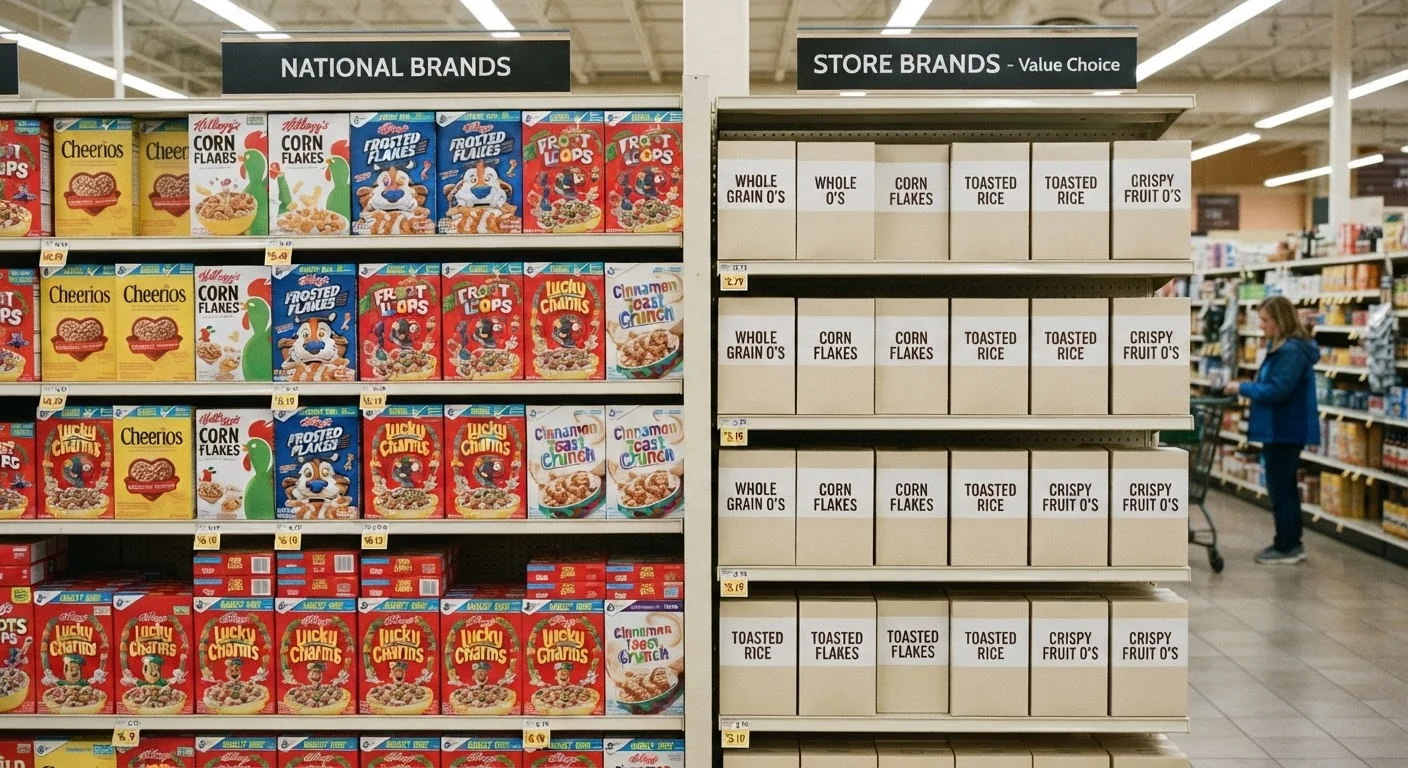
Option A
Name Brands
The heavily marketed, nationally recognized choice.
Best for: Shoppers who value consistent formulation, brand trust, or products where proprietary recipes and R&D genuinely differentiate quality.
Option B
Store Brands
The manufacturer-sourced, retailer-labeled alternative.
Best for: Budget-conscious shoppers seeking comparable quality at lower prices, especially in commodity and staple categories.
The Factory Secret Most Shoppers Don't Know
Walk down any grocery aisle and you'll find a name brand product next to a store brand that costs noticeably less. The assumption many shoppers make is that the cheaper option must be lower quality. In many cases, that assumption is simply wrong.
A significant share of store brand (also called private-label) products are manufactured by the same companies that produce name brand goods. A food processor might produce a national brand pasta sauce under contract, then fill the retailer's private-label jars on the same line, with an identical or near-identical recipe. The label changes. The price drops. The product is often the same.
This isn't a fringe phenomenon. Private-label manufacturing is a substantial business model. Retailers approach manufacturers with volume guarantees, and manufacturers accept because it keeps their production lines running at capacity. The arrangement benefits both sides - and potentially the shopper, if they know what to look for.
That said, the shared-factory story isn't universal. Some name brand products involve proprietary formulations, patented processes, or controlled sourcing that a private-label version genuinely cannot replicate. The challenge is distinguishing which category you're standing in front of. See our framework for deciding between generic and name-brand products for a category-by-category breakdown.
What the Price Gap Is Actually Paying For
When you pay more for a name brand, you're rarely paying exclusively for a better product. You're also paying for the infrastructure that surrounds it: national advertising campaigns, retail shelf placement fees (known in the industry as slotting fees), celebrity endorsements, packaging design, and the overhead of maintaining a marketing organization.
Store brands carry none of those costs. The retailer controls the shelf, so there are no slotting fees. Marketing spend is minimal. That cost structure is why the price difference is often 20-40% - not because the product inside is inferior, but because the cost-to-produce and cost-to-sell are both lower.
| Criterion | Name Brands | Store Brands |
|---|---|---|
| Average price premium | 20-40% higher | Baseline price |
| Marketing & advertising costs baked in | Yes - significant | Minimal to none |
| Manufacturing origin | Brand-owned or contracted | Often same contracted facilities |
| Ingredient/formula transparency | Proprietary; may differ | Often equivalent; check label |
| OTC drug equivalency | Regulated active ingredient | Same regulated active ingredient |
| Warranty & support (non-food) | Often stronger | Variable; retailer-dependent |
| Formulation consistency over time | Generally stable | Can change with supplier |
This doesn't mean the premium is never worth it. If a name brand's marketing budget has also funded genuine R&D - a better drug delivery mechanism, a demonstrably more effective cleaning agent, or a food product with a truly distinct flavor profile - then the premium may reflect real value. Price signals reveal surprisingly little about actual quality - understanding the difference matters.
How to Actually Compare Them in the Store
The most reliable comparison tool most shoppers overlook is the ingredient list. For food products, compare the first three to five ingredients in order - that's where the majority of the product's character comes from. For OTC medications, the active ingredient and its concentration are regulated and standardized, making the generic version legally equivalent in that critical dimension. Always confirm specifics with a pharmacist.
The second tool is unit pricing - the per-ounce or per-count cost shown on the shelf label. Once you're comparing equivalent products, unit price cuts through package-size confusion to show the true cost difference.
OTC Medications: A Regulated Exception
For over-the-counter drugs in the United States, the FDA requires that generic and store-brand versions contain the same active ingredient at the same concentration as the name brand. This makes the active pharmaceutical component legally equivalent - not just similar. However, inactive ingredients (fillers, coatings, dyes) can differ and may matter for individuals with specific sensitivities. Consult a pharmacist before switching if you have concerns about a particular formulation.
For non-food categories - personal care, cleaning products, paper goods - the comparison is less straightforward because formulation differences are harder to verify on a label. Here, a small trial purchase of the store brand is often the most practical research method before committing to a larger quantity. See our take on bulk buying decisions before stocking up on either option.
One practical note: store brand quality isn't static. Retailers periodically reformulate or change suppliers to maintain margins, which can mean a product you liked last year has quietly changed. If you notice a difference, it may not be your imagination. The math of when to pay full price vs. wait applies here too - promotional pricing on name brands occasionally closes the gap enough to make the name brand the rational choice temporarily.
The content provided on our blog site traverses numerous categories, offering readers valuable and practical information. Readers can use the editorial team’s research and data to gain more insights into their topics of interest. However, they are requested not to treat the articles as conclusive. The website team cannot be held responsible for differences in data or inaccuracies found across other platforms. Please also note that the site might also miss out on various schemes and offers available that the readers may find more beneficial than the ones we cover.