

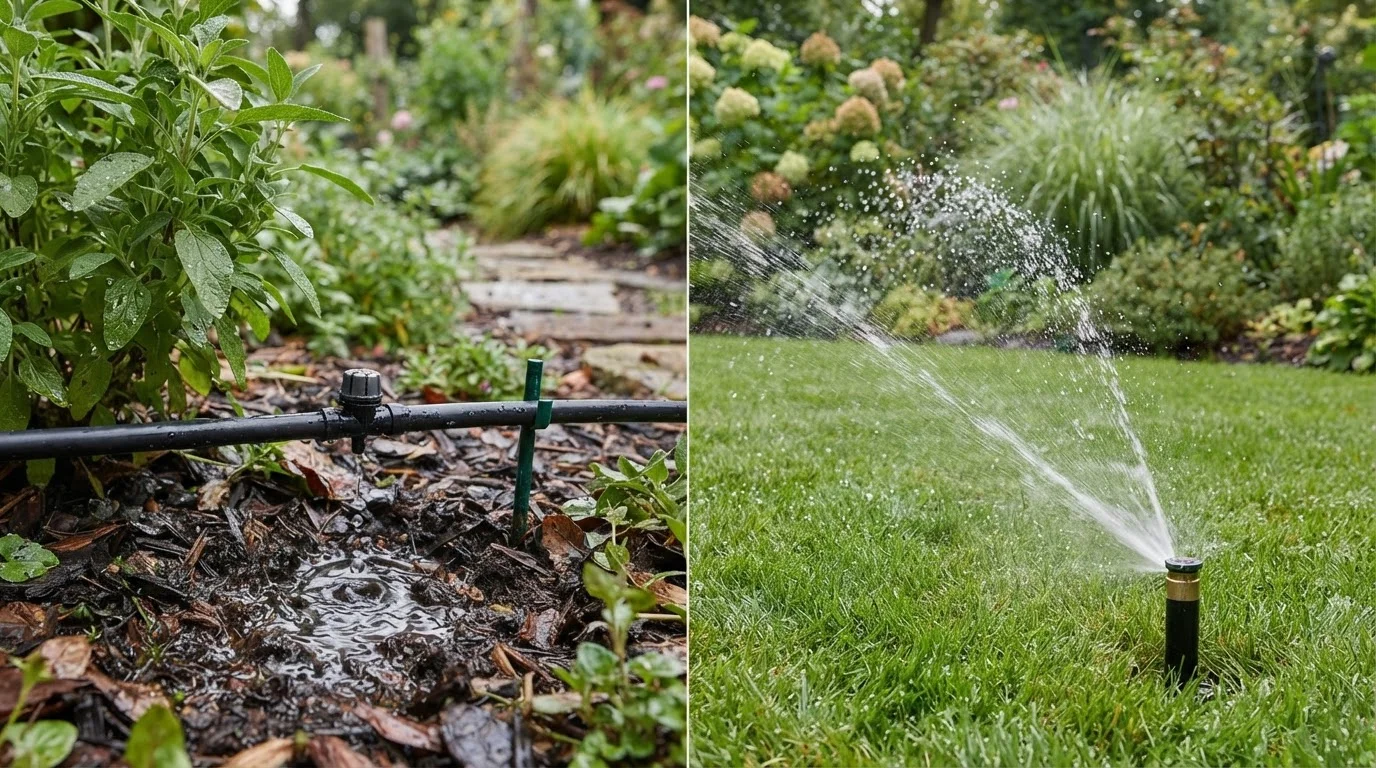
Option A
Drip Irrigation
The precise, low-volume delivery system.
Best for: Vegetable beds, shrubs, and any planting where water should go directly to roots with minimal waste.
Option B
Sprinkler Systems
The broad-coverage, overhead watering solution.
Best for: Lawns and large open plantings where even, wide-area coverage matters more than precision.
How Each System Actually Works
Drip irrigation and sprinklers both move water from a source to your plants, but the mechanics - and the outcomes - are quite different.
Drip irrigation uses a network of tubing and small emitters placed near individual plants. Water seeps out slowly, usually measured in gallons per hour rather than per minute, soaking directly into the root zone. Because water never travels through the air, it can't evaporate mid-flight or drift with the breeze. The soil surface between plants often stays dry, which can reduce weed germination in planting beds.
Sprinklers distribute water overhead in a spray or rotating arc. Stationary, oscillating, and rotary heads each cover ground differently, but all deliver water across the soil surface uniformly - or close to it. That broad delivery is exactly what lawn grass needs, since every blade of turf is also a leaf that absorbs moisture. However, overhead spray also wets stems and foliage on other plants, which can set the stage for fungal issues under humid conditions.
Certain watering habits cause slow, compounding damage - and choosing the wrong delivery method for your plant type is one of the most common.
| Criterion | Drip Irrigation | Sprinkler Systems |
|---|---|---|
| Water delivery | At root level, slow and targeted | Overhead, broad coverage |
| Water efficiency | High - minimal evaporation | Moderate - wind and heat cause losses |
| Foliage contact | None - foliage stays dry | Yes - leaves and stems get wet |
| Best application | Vegetable beds, shrubs, borders | Lawns, seeded areas |
| Setup complexity | Moderate - layout planning needed | Low (portable) to high (in-ground) |
| Maintenance | Emitter cleaning, seasonal replanning | Head adjustment, winterization |
| Weed suppression | Better - dry soil between plants | Lower - wets entire surface |
Where Each Method Performs Best
The best irrigation method depends on what you're growing and how your yard is laid out.
Drip Irrigation Strengths
- Vegetable gardens: Tomatoes, peppers, squash, and most food crops thrive when water reaches roots consistently without wetting leaves. If you're starting a vegetable garden from scratch, a drip system is worth planning in from the beginning.
- Raised beds: The confined root zones in raised beds pair well with drip lines that target each row directly.
- Slopes and slopes: Slow emitter flow allows water to absorb before running off, making drip practical on graded terrain where sprinklers would cause erosion.
Sprinkler Strengths
- Lawns: No practical alternative delivers the even surface coverage that grass requires across hundreds of square feet.
- Newly seeded areas: Germinating seed needs consistent moisture at the soil surface - drip emitters are too localized for this stage.
- Large, open flower beds: When beds contain dense, low-growing annuals with similar water needs, overhead coverage can be efficient and adequate.
Mixing both systems by zone is common in established landscapes. Understanding how perennials and annuals differ in their water needs also helps you decide which areas to equip with which method.
Timing Matters With Both Methods
Regardless of delivery method, early morning is generally the best time to water. Morning watering gives foliage time to dry before evening, reducing disease risk, and avoids peak evaporation periods in the middle of the day. Watering at night - especially with sprinklers - leaves leaves wet for hours, which can encourage mold and mildew in susceptible plants. Automating either system with a timer is one of the simplest ways to stay consistent without guessing.
Installation, Maintenance, and Cost Considerations
Neither system is free of maintenance, but they demand attention in different ways.
Drip systems require layout planning - you need to map emitter placement to match your plant spacing, and that layout may need updating each season as plantings change. Emitters can clog, particularly in areas with hard water, so periodic flushing or filter cleaning is part of upkeep. On the other hand, the components are modular, relatively affordable individually, and don't require professional installation for most home gardens.
Sprinkler systems - particularly in-ground systems with pop-up heads - involve more significant installation work. Underground pipes, a backflow preventer, and a controller are all part of a permanent system. These jobs often benefit from professional installation, and any work connecting to your home's water supply should be reviewed against local codes. Portable sprinklers are far simpler but require manual repositioning and oversight.
Pairing either irrigation method with mulch extends its effectiveness considerably. Different mulch types retain moisture differently, so matching your mulch to your watering method can meaningfully reduce how often you need to run any system.
30-50%
Water savings with drip vs. overhead spray
The U.S. Environmental Protection Agency estimates drip irrigation can use 30 to 50 percent less water than conventional overhead systems, depending on plant type and climate.
50%
Outdoor water lost to inefficient methods
According to the EPA's WaterSense program, approximately half of outdoor residential water use is lost to evaporation, wind, and runoff from inefficient irrigation practices.
The content provided on our blog site traverses numerous categories, offering readers valuable and practical information. Readers can use the editorial team’s research and data to gain more insights into their topics of interest. However, they are requested not to treat the articles as conclusive. The website team cannot be held responsible for differences in data or inaccuracies found across other platforms. Please also note that the site might also miss out on various schemes and offers available that the readers may find more beneficial than the ones we cover.